Type Inspector
The type-instability inspector shows a method's source code annotated with the inferred types — in the spirit of Cthulhu.@descend — and lets the user descend through its call sites. It can be entered in two ways:
- Pressing
ion any frame of a viewer whose row carries a method instance; - Directly, through the
descendmode:
@scope descend f(x, y)The call is not executed; only its argument types are used to select the inspected method specialization. The function form takes the argument types explicitly:
scope_descend(f, Tuple{Int, Float64})The inspector is backed by Cthulhu, which is loaded automatically on the first use (with a status notice, since it takes a moment). Loading Cthulhu invalidates compiled code of unrelated packages, which is why it is not loaded before it is needed.
The Viewer
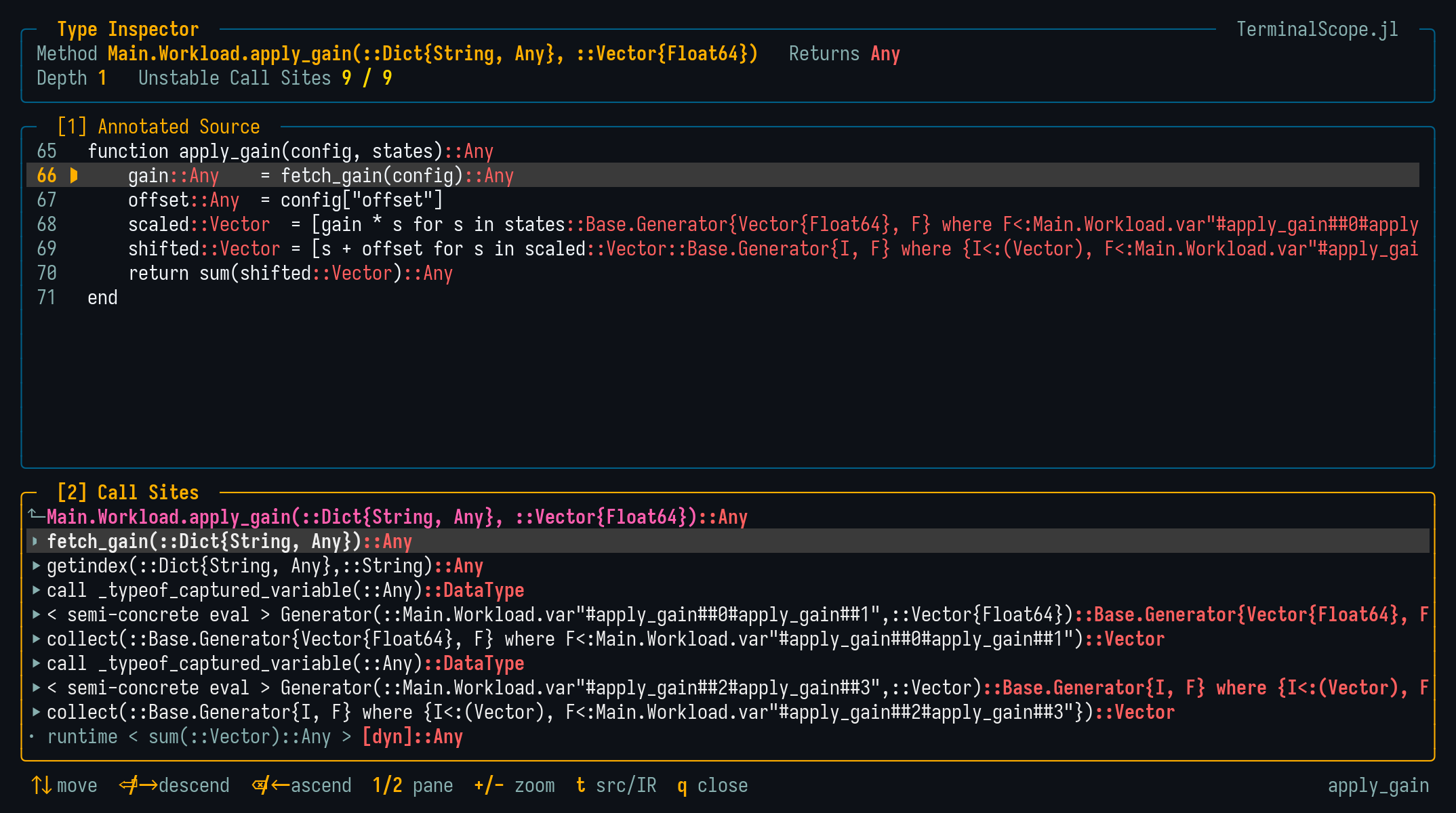
The top pane shows the annotated source of the inspected method: the inferred types are attached to the expressions whose type is not concrete, colored by stability using the theme colors (which adapt to the light variant):
- Error color (coral): An abstract type — the classic type instability;
- Warning color (gold): A small
Union, which Julia usually handles well; - Primary color (cyan): A concrete (stable) type.
The t key toggles the pane to the typed IR (the @code_warntype-like view), which is also used automatically when the source cannot be mapped (e.g. generated functions).
The bottom pane lists the call sites of the method with their inferred return types, colored by the same convention. Union-split call sites list each target as a sub-entry (↳), and dynamic dispatches are tagged with [dyn]. The source pane highlights and centers the line of the selected call site.
Enter/→descends into the selected call site;Backspace/←ascends back to the caller;eopens the inspected method in the editor at its definition;q/Esccloses the inspector, returning to the view it was opened from.
The header shows the inspected method, its inferred return type, the descend depth, and how many call sites are type-unstable.
Examples
julia> using TerminalScope

julia> unstable(x) = x > 0 ? 1 : 2.0;

julia> caller(x) = unstable(x) + 1;

julia> @scope descend caller(1)